The 2025–2030 Dietary Guidelines Explained: What They Get Right, What They Miss, and Why It Matters
By Nicole Randazzo, MA, RDN, CDCES
As a Registered Dietitian, I want to start by saying this, there are parts of the 2025–2030 Dietary Guidelines for Americans (DGA) that I genuinely agree with. Some updates reflect where nutrition science has been for years.
But there are also mixed messages, contradictions, and political undertones that deserve a closer look—especially given how loudly these guidelines are being marketed as a solution to America’s chronic disease crisis.
This isn’t about tearing everything down. It’s about asking better questions.
Why the Dietary Guidelines Matter (Even If You’ve Never Read Them)
The Dietary Guidelines for Americans (DGA) are jointly issued by the U.S. Department of Agriculture (USDA) and the Department of Health and Human Services (HHS) every five years. They serve as the federal government’s official nutrition recommendations.
You may never Google the newest DGA graphic but that doesn’t mean they don’t affect you.
Who Uses the DGA?
Federal agencies and policymakers rely on the guidelines to shape national nutrition policy. Agencies like the USDA, HHS, CDC, and CMS use them as a foundation for regulations, public health initiatives, and clinical guidance.
Federal nutrition programs are built on them, including:
- National School Lunch Program (NSLP) and School Breakfast Program (SBP)
- Child and Adult Care Food Program (CACFP)
- Women, Infants, and Children (WIC)
- SNAP education components (SNAP-Ed)
Health professionals and educators like dietitians, clinicians, and public health practitioners, use the DGAs to guide counseling, education materials, and community programs.
So while the average American may never study the graphic itself, the DGA influence what foods are served in schools, what nutrition education is funded, what’s prioritized in healthcare, and what guidance you hear in a one-on-one session with a dietitian.
Let’s Start With What the Guidelines Get Right
There are positives worth acknowledging.
1. Inclusion of Frozen and Canned Fruits and Vegetables
For the first time, the guidelines explicitly include frozen and canned produce. This matters.
- Frozen fruits and vegetables provide comparable nutritional value to fresh.
- Canned foods can be excellent options, especially when budgets, access, or time are limited.
- Rinsing canned fruits, vegetables, or beans can reduce sodium by up to 60%, which is a practical, evidence-based recommendation.
This is a step toward acknowledging real-world access and it aligns well with the written emphasis on fiber and microbiome health.
2. Emphasis on Fiber, Gut Health, and Fermented Foods
Gut health finally gets a mention for the first time per previous past DGAs.
The guidelines reference:
- Fermented foods like kefir, kimchi, and miso
- High-fiber foods to support beneficial gut bacteria
This may be a small paragraph on their 10 page brief, but it reflects a meaningful shift toward recognizing the gut–metabolic health connection.
3. Protein Recommendations Catching Up to the Science
The increase from 0.8 g/kg to 1.2–1.6 g/kg of protein is a substantial change and one that aligns more closely with what many dietitians already recommend, especially for:
- People pursuing weight loss
- To preserve lean body mass
- Those managing blood sugar
- For active individuals
However, framing this as “ending the war on protein” is misleading. Protein was never discouraged in prior guidelines; it simply wasn’t emphasized in the same way. The marketing narrative oversells the shift.
4. The Saturated Fat Limit
The written guidelines maintain the longstanding recommendation to limit saturated fat to no more than 10% of total daily calories, while prioritizing unsaturated fats.
This consistency matters but as I go into later, the visual tells a very different story.
Where the Guidelines Start to Fall Apart
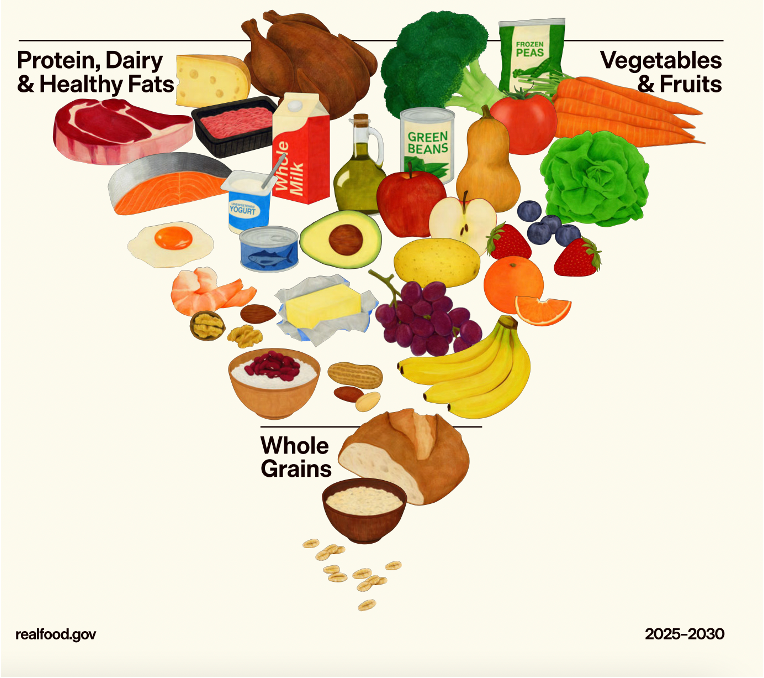
1. The Visual: An Inverted Pyramid That Confuses More Than It Clarifies
Let’s address the elephant in the room: the return of the food pyramid.
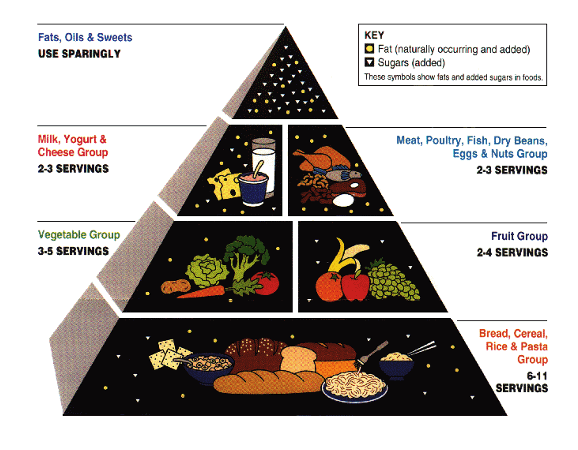
We moved away from the food pyramid in 2011 for a reason. The MyPlate model worked because it was intuitive, meal-based and grounded in real-life portions.
The new inverted pyramid feels abstract and regressive. It resembles the 1992 Food Pyramid, which was retired precisely because it confused the public.
There wasn’t a visual problem that needed solving.

2. Whole Grains Are Undermined by the Graphic
In the text, the guidelines recommend 2–4 servings of whole grains per day.
But visually? A few scattered oats at the bottom of the pyramid sends the message that whole grains should be minimal compared to the foods above it like butter and olive oil. Really?
This is misleading.
- The brain alone requires ~120–130 g of carbohydrates per day for basic function.
- Whole grains are one of our most reliable sources of fiber, which the guidelines themselves emphasize.
The visual contradicts the science.
3. Fats: Conflicting Messages Everywhere
Healthy, unsaturated fats like olive oil and avocado are essential components of a balanced diet, but how they are presented matters.
In the new visual, unsaturated fats are placed centrally and alongside protein and dairy, while foods high in saturated fat, such as cheese, also appear prominently above other categories. This visual emphasis suggests greater importance or volume, even though the written guidelines continue to recommend limiting saturated fat to less than 10% of total daily calories.
At the same time, the written guidance includes repeated references to:
- Butter
- Beef tallow
- Full-fat dairy
- Red meat
IT’s worth noting One tablespoon of beef tallow contains ~6.4 g of saturated fat – over 30% of the daily recommended limit.
The pattern is hard to ignore. Animal-based foods are clearly emphasized, while plant-based protein sources appear minimally and without clear categorization. There is no distinct visual grouping for plant proteins such as beans, lentils, or soy, despite strong evidence supporting their benefits for cardiovascular health, fiber intake, and metabolic outcomes.
When visuals elevate foods that are meant to be limited while Under-representing foods the science consistently supports, the result is confusion rather than clarity.
4. Overemphasis on Dairy and Animal Products
The prominence of dairy and animal protein raises concerns especially given:
- Lactose intolerance prevalence
- Vegetarian and vegan diets
- Religious food practices
Plant proteins are noticeably underrepresented.
No lentils. No soy.
This may not be accidental. Advisory committee members and contributors have documented ties to the dairy and beef industries, which can influence emphasis even when broader nutrition science supports more diverse protein sources.
5. Added Sugar: Unrealistic Absolutism for Children
The recommendation of zero added sugar for children under 11 may sound ideal in theory but it ignores developmental, cultural, and behavioral realities.
Nutrition research consistently shows that:
- Extreme restriction can increase food fixation
- Moralizing foods often backfires
- Neutral exposure leads to healthier long-term relationships with food
Are birthday cakes off the table? Are parents expected to eliminate sweets entirely?
Public health guidance must balance ideal with achievable.
6. Alcohol Guidance Becomes Ambiguous
Previous guidelines clearly stated:
- Up to 1 drink per day for women
- Up to 2 for men
The new guidelines remove this specificity without offering clear alternatives—making it harder for Americans to interpret or apply.
7. No Behavioral Context
Other countries’ dietary guidelines incorporate:
- Eating behaviors
- Cultural patterns
- Social determinants of health
These guidelines largely do not.
The Bigger Issue: Politics, Power, and “Make America Healthy Again”
The USDA operates under a fundamental conflict of interest:
- Protecting public health through evidence-based nutrition
- Promoting U.S. agricultural commodities
This administration has leaned heavily toward the latter.
At the same time, policies under the banner of “Make America Healthy Again” include:
- Over $1 billion in cuts to school and local food purchasing programs
- Termination of annual food insecurity reports
- Broader SNAP eligibility and benefit reductions under the One Big Beautiful Bill
So we’re promoting full-fat dairy and red meat all while slashing programs that help schools and food banks access any nutritious food.
That disconnect matters.
Why This Feels Like a Distraction
The rebranding of an old pyramid as something newly creates buzz.
But meanwhile:
- Access to food is shrinking
- Funding for nutrition education is being cut
- Structural supports for health are eroding
If you ask me, MyPlate was not the problem.
What I’ll Continue to Do as a Dietitian
In my practice, I’ll continue using:
- The MyPlate method as a foundation
- With nuance around whole-fat foods and healthy fats
- Without promoting beef tallow
- With realistic carbohydrate needs
- With cultural flexibility and context
Nutrition education works best with clarity, consistency, and real-life application, not upside-down pyramids.
Final Thoughts
There are clear inconsistencies in how fats, dairy, sugars, and alcohol are framed in the 2025–2030 Dietary Guidelines.
I challenge readers to:
- Sit with the disconnect between the visual and the science
- Ask who benefits from the emphasis being promoted
- Follow the money—not just the messaging
Because making America healthy again requires far more than a new graphic.
Fuel Bettr. Feel Bettr.
References
- U.S. Department of Agriculture and U.S. Department of Health and Human Services. Dietary Guidelines for Americans, 2025–2030. https://www.dietaryguidelines.gov

Leave a Reply