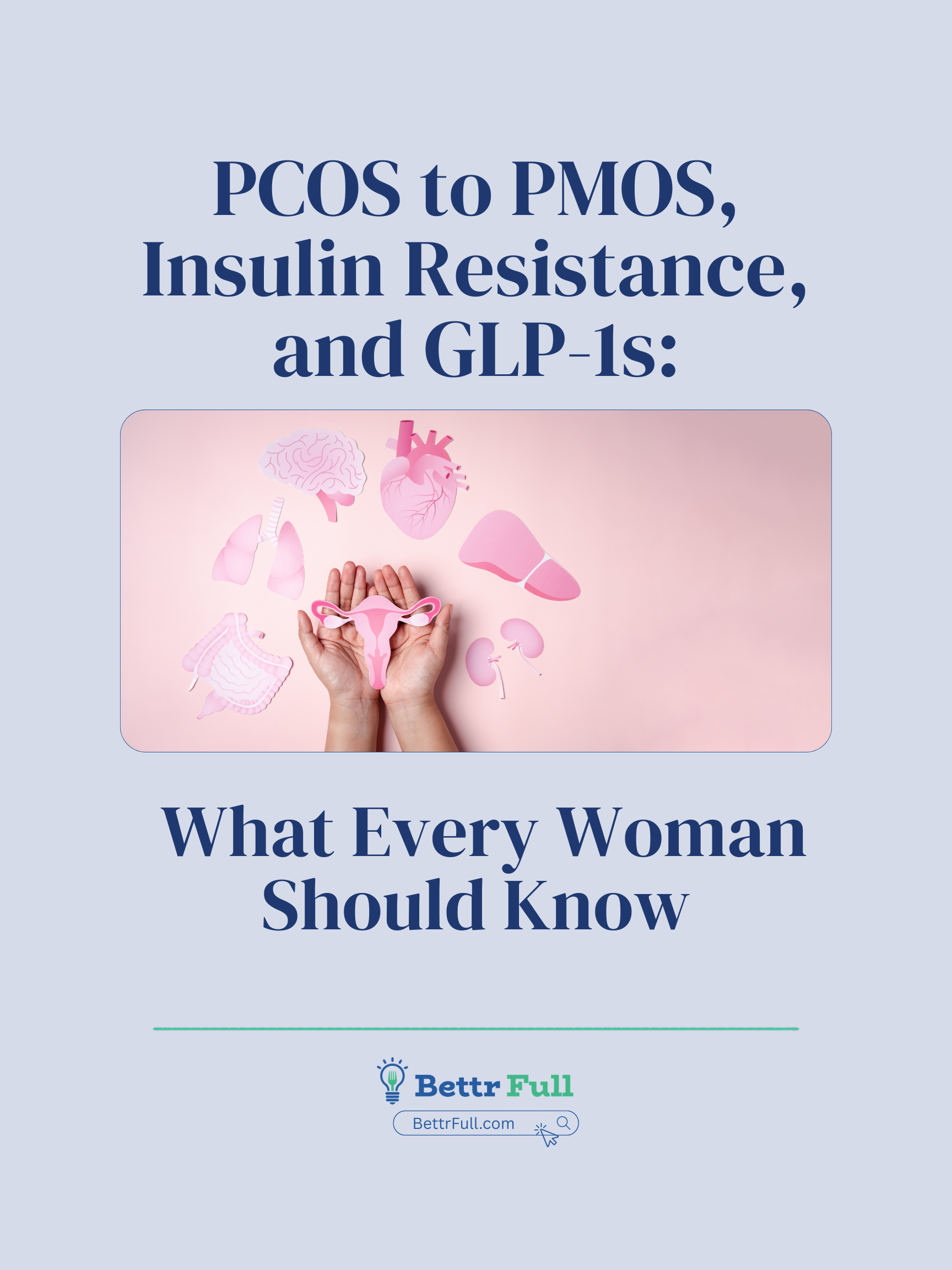
If you’ve ever been diagnosed with Polycystic Ovary Syndrome (PCOS) and were told to “lose weight and go on birth control,” you’re not alone, and you deserve more intervention options and explanation than that.
PCOS has long been one of the most common hormonal conditions affecting women of reproductive age. An estimated 5 million American women are living with PCOS, with prevalence in the US ranging from 7% to 10% of reproductive-age women [1]. Despite that, as many as 75% of patients with PCOS are unidentified in clinical practice [1]. The condition has been chronically misunderstood, mismanaged, and reduced to a fertility problem. A recently proposed name change is starting to shift that, and I think it’s worth talking about.
What Is PCOS, and Why Are We Renaming It to PMOS?
PCOS has traditionally been diagnosed when a woman meets two out of three criteria: irregular or absent ovulation, signs of elevated androgens (like acne, excess hair growth, or elevated testosterone), and polycystic-appearing ovaries on ultrasound.
Here’s where the name starts to fall apart: a woman could receive a PCOS diagnosis without ever showing polycystic ovaries. She might not even have ovaries at all. The word “polycystic ovary” in the name implied the ovaries were the central problem, when in reality, the ovaries are downstream of a much bigger metabolic picture.
That is why renaming PCOS to Polyendocrine Metabolic Ovarian Syndrome (PMOS) is exciting for women’s health. The new name is not just semantics. It is a shift in focus, from the ovaries as the problem, to the metabolic dysregulation that is the undercurrent of the whole condition. Women with PMOS commonly experience:
- Insulin resistance and blood sugar dysregulation
- Impaired glucose metabolism and dyslipidemia
- Hypertension and elevated cardiovascular risk
- Chronic inflammation
- Gut and microbiome imbalances
- Sleep and circadian rhythm dysfunction
- Central weight gain
This is not a condition that lives only in the ovaries. It lives in the entire body.
The Problem with the “Just Lose Weight” Approach to PCOS
For decades, the standard advice for women with PCOS has been to lose weight and go on birth control. I understand why clinicians reach for these tools. But without addressing the root causes of metabolic dysfunction, this advice often backfires.
When women are told to lose weight with no real direction, many under-fuel, over-exercise, and place enormous stress on an already dysregulated system. Chronic undereating raises cortisol. Excessive exercise without proper recovery raises cortisol. And elevated cortisol worsens insulin resistance, which worsens PMOS symptoms. It becomes a cycle that feels impossible to escape, and that is because the intervention was never actually treating the condition.
This is where a nutrition-centered, metabolic approach changes things.
In my practice, I focus on balancing carbohydrates in the diet, with specific attention to the timing and composition of meals. I also prioritize fiber variety because fiber does two critical things for women with PMOS: it helps stabilize blood sugar, and it feeds the beneficial bacteria in the gut that support hormone regulation. These are not trendy nutrition tactics. They are foundational interventions that address the actual drivers of PMOS.

GLP-1 Receptor Agonists for PCOS: What the Research Is Showing
One of the most significant developments in PMOS management over the last few years is the growing body of research on GLP-1 receptor agonists (GLP-1 RAs), medications like semaglutide (Ozempic, Wegovy) and liraglutide (Victoza, Saxenda).
GLP-1 RAs work by mimicking a natural gut hormone that regulates blood sugar, appetite, and insulin secretion. They were originally developed for type 2 diabetes but are now being studied extensively for their potential role in PMOS.
Here is what the data shows so far:
Weight and metabolic markers. Meta-analyses of randomized controlled trials show that GLP-1 RAs significantly reduce BMI, waist circumference, triglycerides, and total testosterone in women with PCOS. When compared directly to metformin, the traditional first-line medication for PMOS, GLP-1 RAs outperformed it in improving insulin resistance, blood pressure, cholesterol, menstrual irregularities, and androgen levels [2].
Menstrual cycle regularity. In a 2023 study, low-dose semaglutide (0.5 mg weekly) significantly reduced body weight in nearly 80% of women with PCOS who had not responded to a previous lifestyle intervention. This was also associated with meaningful improvement in insulin resistance and menstrual cycle regularity [3].
Hormonal balance. Perhaps most compelling: when liraglutide was combined with metformin, 92% of women with PCOS achieved menstrual cycle recovery, alongside significant improvements in LH, FSH, estradiol, progesterone, total testosterone, SHBG, and free androgen index [3].
Androgen reduction. Clinical trials suggest GLP-1 RAs may reduce serum androgen levels, support ovulatory function, and help normalize menstrual cycles. Studies on liraglutide specifically show reductions in free testosterone alongside the expected weight and metabolic benefits [4].
Newer agents: tirzepatide and retatrutide. Research is also expanding beyond semaglutide and liraglutide. Tirzepatide (Zepbound), a dual GLP-1 and GIP receptor agonist, and retatrutide, a triple agonist currently seeking FDA approval, are both showing even greater improvements in weight and insulin sensitivity compared to traditional treatment approaches [5].
An important note: GLP-1 RAs are currently used off-label for PCOS and PMOS. No GLP-1 RA has received FDA approval for this specific indication. The evidence is promising, especially for metabolic and androgen-related outcomes, and the combination of a GLP-1 RA with metformin appears to yield the strongest hormonal results so far. Reproductive safety in non-obese populations is still an open question and one the research community needs to continue investigating.
My Hope for the Future of Women’s Metabolic Health
The name change from PCOS to PMOS is a step in the right direction. It acknowledges that this condition is systemic, not localized, and that women deserve an understanding that reflects how their bodies actually work.
But a name change alone is not enough.
My hope is that insurance companies and the healthcare system invest in earlier metabolic screening for women, including fasting insulin and fasting glucose, not just after a PMOS diagnosis, but routinely, as a part of preventive care. Catching insulin resistance early changes the trajectory of this condition significantly.
I also hope the research funding follows. Women’s health has historically been underfunded and understudied, and PMOS is a clear example of what happens when we leave half the population’s health on the back burner [6].
And I hope the cultural conversation around PMOS shifts. For too long, the primary framing has been about fixing fertility. That framing leaves out the millions of women who are not trying to conceive but are still living with chronic fatigue, weight struggles, irregular cycles, and elevated cardiovascular risk. Optimizing long-term metabolic health is the goal, and that matters for every woman with this diagnosis, regardless of whether she ever wants to get pregnant.
The positives are tangible. The shift toward seeing PMOS as a condition of the whole body, not just the ovaries, is already changing how clinicians, researchers, and women themselves think about it. That is worth celebrating.
You Are Not Broken
Whether you’ve been diagnosed with PCOS or PMOS, suspect you might have it, or simply feel like your body has been working against you, I want you to know that your symptoms are not random, and your body is not broken.
Looking more closely at your diet and daily habits can meaningfully change how you feel in your body and how it responds. This is not about restriction or punishment. It is about giving your body what it actually needs to regulate itself.
As a dietitian who specializes in metabolic health and blood sugar management, I work with women navigating exactly these challenges. PMOS has real implications for insulin sensitivity, lipid levels, energy, and long-term disease risk, and nutrition is one of the most powerful tools we have to address them.
If you are ready to stop being handed a prescription and a vague instruction to “eat less,” I would love to work with you. Book a discovery call or follow along on Instagram for more nutrition updates.
Fuel Bettr. Feel Bettr. 💙
Sources
[1] Siddiqui S, et al. Association of Polycystic Ovarian Syndrome Features and Metabolic Syndrome Among Reproductive-Aged Women in the United States. PMC. https://pmc.ncbi.nlm.nih.gov/articles/PMC12040555/
[2] Morais BAA, et al. The efficacy and safety of GLP-1 agonists in PCOS women living with obesity in promoting weight loss and hormonal regulation: A meta-analysis of randomized controlled trials. Journal of Diabetes and Its Complications. 2024;38(10):108834. https://pubmed.ncbi.nlm.nih.gov/39178623/
[3] Tosi F, et al. Endocrine and metabolic effects of GLP-1 receptor agonists on women with PCOS, a narrative review. Endocrine Connections. 2025;14(5). https://pmc.ncbi.nlm.nih.gov/articles/PMC11949528/
[4] Hoteit BH, et al. The dual impact of GLP-1 receptor agonists on metabolic and reproductive health in polycystic ovary syndrome. Therapeutic Advances in Endocrinology and Metabolism. 2025. https://journals.sagepub.com/doi/10.1177/20420188251383064
[5] Rahim S, Pergolizzi J. The Potential Role of Glucagon-Like Peptide-1 (GLP-1) Agonists for Polycystic Ovary Syndrome. Cureus. 2025;17(1):e77998. https://pmc.ncbi.nlm.nih.gov/articles/PMC11852098/
[6] Utilizing a digital cohort to understand the health burden and lifestyle characteristics across the life course in individuals with polycystic ovary syndrome. PMC. https://pmc.ncbi.nlm.nih.gov/articles/PMC12491046/