
The Unsung Hero of Weight Management and Blood Sugar Balance: Fiber
By Nicole Randazzo, MA, RDN, CDCES
At this point, most of us have heard about protein—it’s the go-to nutrient for staying full and building muscle. But there’s another nutrient that deserves just as much spotlight when it comes to weight management and blood sugar balance: dietary fiber.
What Exactly Is Fiber?
Fiber is actually a type of carbohydrate, but here’s the twist—it doesn’t fully digest in your body. Instead, it moves through your system doing amazing behind-the-scenes work for your health. There are two main types of fiber:
Soluble fiber: Dissolves in water to form a gel-like substance. This is the type that helps lower cholesterol, regulate blood sugar, and even protect your heart. You’ll find it in foods like black beans, Brussels sprouts, sweet potatoes, avocado, and pears.
Insoluble fiber: Passes through your digestive system mostly intact, adding bulk to your stool and helping everything “move along.” Think whole wheat flour, wheat bran, cauliflower, green beans, and potatoes.

The Health Payoff of Fiber
We often think of fiber as the thing that “keeps us regular”—and while that’s true, it does so much more.
Chronic disease protection: A massive analysis of nearly 250 studies found that people who ate the most fiber lowered their risk of heart disease, stroke, type 2 diabetes, and colon cancer by 16–24% compared to those who ate very little (Reynolds et al.). Even better? For every additional 8 grams of fiber per day, the risk dropped another 5–27%.
Blood Sugar & Fiber: Soluble fiber forms a gel in your gut, slowing how quickly carbs are absorbed and preventing sharp blood sugar spikes after meals. Regular fiber intake can also improve insulin sensitivity. Plus, fiber feeds the “good” bacteria in your gut, supporting a healthier microbiome, better glucose control, and less inflammation.
Weight control: Fiber helps meals “stick” with you longer.
In one large study, adults who ate several servings of whole grains daily gained less weight than those who rarely ate them (Mozaffarian et al.).
How Much Fiber Do You Actually Need?
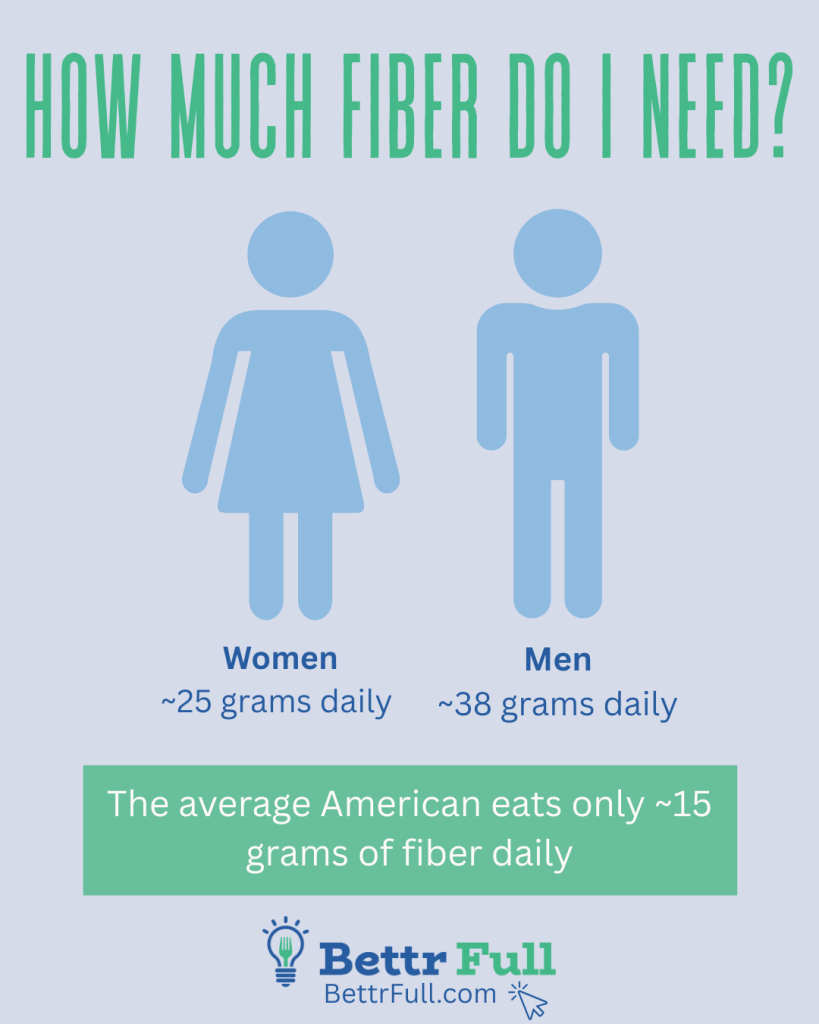
Here’s where it gets real: the average American only eats 10–15 grams of fiber per day. The USDA recommends:
- Women (under 50): 25+ grams/day
- Men (under 50): 38+ grams/day
- Women (50+): 21 grams/day
- Men (50+): 30 grams/day (U.S. Department of Agriculture).
That’s almost double—or even triple—what most of us are eating!
Smart Label Reading Tips
When grocery shopping, don’t be fooled by terms like “multigrain” or “12 grain.” Always check the ingredients list: the first word should be “whole.”
Some quick label hacks:
- Cereals: ≥6 grams of fiber/serving
- Breads & crackers: ≥3 grams/serving
- Pasta: ≥4 grams/serving
- Bonus trick: look for at least 1 gram of fiber per 10 grams of carbs (a 1:10 ratio). A 1:5 ratio is even better!
Easy Ways to Add More Fiber
- Start your day with a high-fiber cereal or oatmeal.
- Add 2 tbsp chia seeds and/or ground flax into smoothies or yogurt.
- Add beans, lentils, or peas to soups and chilis.
- Snack on veggies with hummus, guacamole, or salsa.
- Top salads with berries, nuts, and seeds.
- Swap refined grains for whole grains whenever possible.
Gentle Tips for Success
- Go slow: Add fiber gradually to avoid stomach discomfort.
- Stay hydrated: Drink more water as you increase fiber.
- Check in with your doctor if you have digestive concerns before making big changes.
The Takeaway
Fiber is more than just “roughage”—it’s a powerful nutrient that helps regulate appetite, control weight, protect against disease, and support long-term health. Think of it as your natural appetite manager and blood sugar stabilizer.
By building your meals with whole grains, legumes, fruits, and vegetables, you’ll not only feel fuller longer but also give your body the tools it needs to thrive.
Works Cited
- Mozaffarian, Dariush, et al. “Changes in Diet and Lifestyle and Long-Term Weight Gain in Women and Men.” New England Journal of Medicine, vol. 364, no. 25, 2011, pp. 2392–2404.
- Park, Yikyung, et al. “Dietary Fiber Intake and Mortality in the NIH-AARP Diet and Health Study.” Archives of Internal Medicine, vol. 171, no. 12, 2011, pp. 1061–1068.
- Reynolds, Andrew, et al. “Carbohydrate Quality and Human Health: A Series of Systematic Reviews and Meta-Analyses.” The Lancet, vol. 393, no. 10170, 2019, pp. 434–445.
- U.S. Department of Agriculture and U.S. Department of Health and Human Services. Dietary Guidelines for Americans, 2020–2025. 9th Edition.
Leave a Reply