The Bounce-Back Theory
By Nicole Randazzo, MA, RDN, CDCES
Coming back from time away in Asia, I found myself reflecting on something I talk about with nearly every client.
Some mornings began without a workout — just the hum of motorbikes outside my window and warm air settling into the day. Other evenings ended in bustling night markets, savoring mango sticky rice fresh from the steamer, hazelnut roti (crepe) or a silky cup of Vietnamese chè layered with coconut milk and mung beans.
My routine looked different. My movement looked different. My food choices looked different.
And yet, something felt steady.
Instead of those moments triggering guilt or the familiar “I’ll have to make up for this later” thoughts, I found myself fully present. Enjoying the sweetness, the textures, the experience of being somewhere new.
Because I trusted something I’ve spent years building: my ability to return to supportive habits.
My bounce-back rate.
That confidence meant a missed workout or an extra local sweet didn’t spiral into stress or steal mental space from the experience. I knew I’d come back to my routines, my structure, and my habits when the time was right.
And that trust allowed me to fully enjoy where I was.
That reflection brought me back to a conversation I have with nearly every client at some point:
How do you bounce back after feeling like you’ve fallen off track?
Because here’s the truth:
Backsliding is part of the betterment journey.
It is unrealistic to think you’ll make lifestyle changes and never regress. That’s not how human beings work.
Life happens. Stress spikes. Travel disrupts routines. Unexpected events throw off structure.
What matters isn’t whether you slip.
What matters is how quickly you recover.
What is a “Bounce-Back Rate”?
Your bounce-back rate is how quickly you return to supportive habits — physically and psychologically — after a disruption.
A shorter bounce-back rate means:
- less time stuck in guilt or shame
- less “all-or-nothing” thinking
- greater consistency over time
- more sustainable progress
Instead of spiralling After A Not-So-Great Decision, You Make The Next Supportive Choice, Or, As I Phrase It To my client, “make the next right decision”.
This principle applies beyond nutrition — to movement, sleep, productivity, finances, and any habit you want to apply sustain long-term.
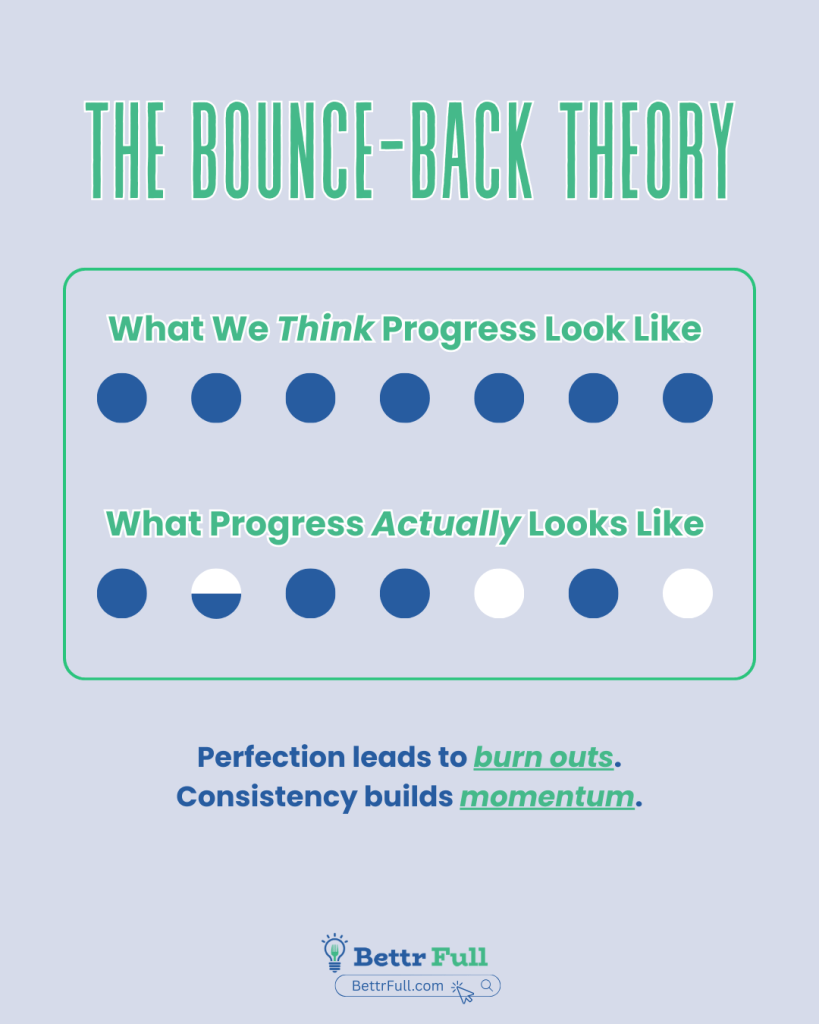
Why Rigid Thinking Keeps You Stuck
When your mindset becomes more flexible and less rigid, you become less fearful of failure and more resilient when challenges arise.
Think about this scenario:
You miss the gym for a week and tell yourself:
“I’ll start Monday.”
“I’ll restart next month.”
“I’ll get back on track after the holidays.”
Then another slip happens… and the restart date keeps moving.
This is common.
Research suggests that roughly 80% of New Year’s resolutions fail by February, often because of all-or-nothing thinking and unrealistic expectations.
The issue isn’t motivation.
It’s rigidity.
How to Shorten Your Bounce-Back Rate
Resilience isn’t built through perfection.
It’s built through repeatable actions that make it easier to return to supportive habits.
Here are tangible ways to shorten your bounce-back rate:
1) Remove the “Restart Mentality”
You don’t need a Monday, a new month, or a new year.
Your next decision is your reset. Think of the language there and the shift of opportunity.
One balanced meal.
One walk.
One earlier bedtime.
This all counts.
2) Use the 24-Hour Rule
If a day feels off-track, focus on getting back to supportive habits within 24 hours.
This prevents one moment from turning into a week.
Consistency lives in the return — not perfection.
3. Anchor Back to One Keystone Habit
Instead of trying to fix everything at once, return to one supportive behavior:
- eating protein at meals
- drinking enough water
- adding vegetables to one meal
- going for a 10-minute walk
- keeping a consistent bedtime
Small anchors rebuild momentum.
4) Drop the Guilt Narrative
Guilt prolongs the bounce-back process.
Curiosity shortens it.
Instead of:
“I ruined everything.”
Try:
“What was going on today, and what would help tomorrow feel easier?”
5) Build a Flexible Routine (Not a Perfect One)
Rigid routines break under stress.
Flexible systems bend and recover.
Think in ranges instead of absolutes:
✔ movement most days
✔ protein most meals
✔ vegetables daily
✔ sleep priority when possible
Flexibility supports consistency.

6. Expect Disruption (So You’re Not Surprised by It)
Travel. Busy seasons. Illness. Holidays. Stressful weeks.
These aren’t failures.
They’re part of real life.
Planning for disruption makes returning to routine faster and easier.
7) Practice the “Next Right Decision”
Progress is not made in perfect streaks.
It’s built in small pivots.
Not the perfect day.
Not the perfect week.
Just the next supportive choice.
The Power of the Next Right Decision
Resilience is built in small moments.
When you focus on making the next right decision — instead of striving for perfection — your bounce-back rate shortens.
This builds:
- resilience
- self-trust
- confidence
- emotional flexibility
Over time, this confidence spills into other areas of life:
✔ work
✔ parenting
✔ movement habits
✔ stress management
✔ long-term goal setting
Why This Matters (and Where Support Helps)
This is one of the core concepts we work through in nutrition counseling.
Because improving your relationship with food isn’t just about what’s on your plate.
It’s about how you think, respond, adapt, and care for yourself when life inevitably disrupts your routine.
In many ways, nutrition counseling can feel like therapy for food-related behaviors — but what unfolds often goes far beyond food.
Clients build self-trust.
They release perfectionism.
They learn resilience.
They gain confidence in their decision-making.
And that confidence spills into other areas of life — work, relationships, parenting, movement, and stress management.
When you learn how to recover instead of restart, you stop fearing setbacks.
You start trusting yourself.
And that’s where sustainable change begins.
Fuel Bettr. Feel Bettr. 💙

Leave a Reply