What Vietnam Can Teach Us About Weight Management
By Nicole Randazzo, MA, RDN, CDCES
Reflections from a weight-loss dietitian after visiting Vietnam
I recently returned from a short two-day stint in Vietnam during my travels through Southeast Asia.
Two days isn’t nearly enough time to fully experience a country, but it was enough for me — as a registered dietitian who focuses on weight loss and metabolic health — to start noticing patterns around food.
And one statistic immediately caught my attention.
Vietnam has one of the lowest obesity rates in the world 2.1%.
For comparison, the United States has an obesity rate of around 42%.
As someone who spends most of my professional life helping clients navigate weight management in the U.S., I couldn’t help but become curious about why the difference is so dramatic.
Although my time in Vietnam was brief, the experience prompted me to look deeper into the culture around food and many of the patterns I noticed during those two days aligned with what the research shows.
Here are a few things that stood out.
Meals Are Slower and More Mindful
One of the first cultural shifts I noticed was the pace of meals.
Meals weren’t rushed.
People sat, talked, and lingered. More than once, we actually had to ask the server for the check. Something that felt unusual coming from New York, where restaurant culture can sometimes make you feel subtly pressured to finish quickly so the next table can sit.
This slower style of eating also supports mindful eating.
From a physiological standpoint, this matters more than many people realize.
It takes about 20 minutes for the brain to receive the signal of fullness from the stomach. When meals are rushed, it’s easy to eat past fullness before the body has time to register that it’s satisfied.
When meals slow down, people naturally give their bodies time to recognize those fullness signals — which can help regulate portion size without strict dieting.

The Food Is Naturally Balanced
Vietnamese cuisine is built around foods that many dietitians spend time encouraging clients to eat more of:
- vegetables
- fresh herbs
- broth-based dishes
- lean proteins
- minimally processed ingredients
Even popular dishes are relatively balanced.
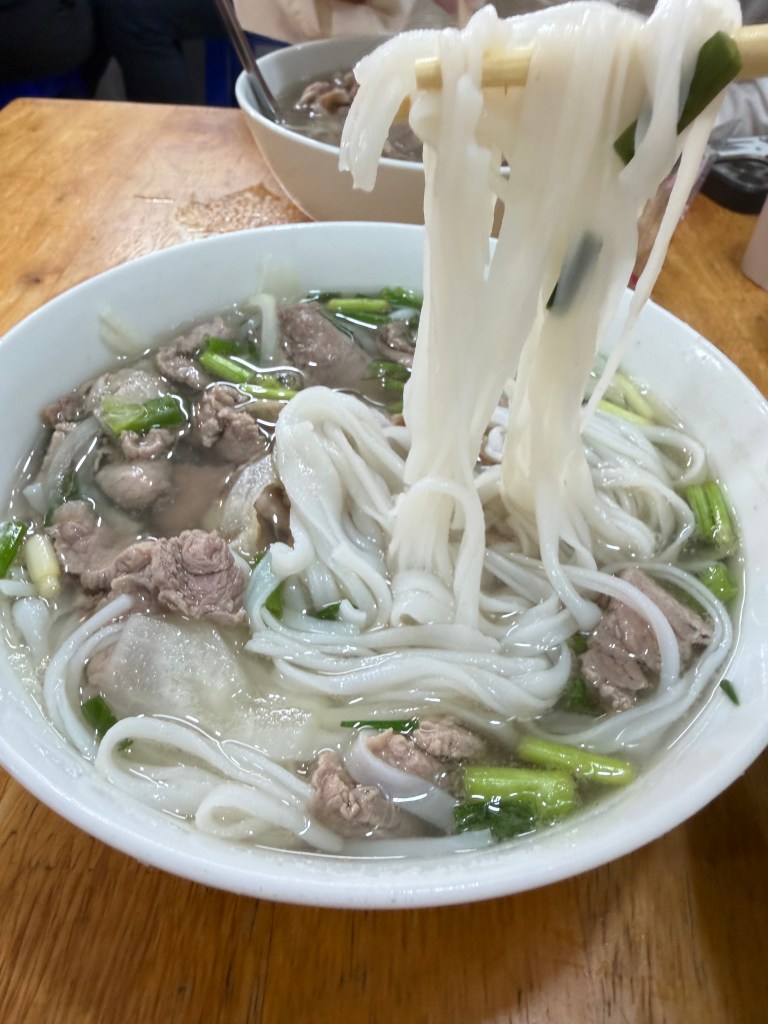
A bowl of pho, a broth-based noodle soup typically served with herbs, vegetables, and protein, is often around 350 calories depending on preparation.
Fresh spring rolls, filled with vegetables, herbs, and shrimp or pork, are often around 150 calories each.
Meals emphasize freshness, flavor, and balance rather than heaviness.
Portions Are Smaller and Often Shared
Another difference I noticed was portion size.
Meals tend to be smaller compared with what many Americans are used to.
When eating out with friends, it’s also common to order several dishes and share them with the table, which naturally moderates portions without anyone needing to consciously restrict food.
Fruit is also frequently enjoyed as dessert, rather than heavily processed sweets.
Fresh Produce Is Widely Available
Vietnam is still a heavily agricultural country, and fresh produce is widely available.
Markets and street vendors selling fruits and vegetables are everywhere, and produce tends to be relatively inexpensive compared with many Western countries.
When fruits and vegetables are both accessible and affordable, they naturally become a larger part of everyday meals.

Cooking Uses Less Oil
Vietnamese cooking also tends to rely on methods like broth-based cooking, grilling, steaming, and fresh ingredients rather than heavy frying.
Average oil consumption is relatively modest compared with many countries, which can reduce excess calories without people intentionally trying to diet.
This matters because oil is extremely calorie dense.
Just 1 tablespoon of cooking oil contains ~120 calories. That might not sound like much, but when oil is used generously in cooking — sautéing, frying, or in sauces — those calories can add up quickly across meals.When a cuisine naturally relies more on broth, herbs, vegetables, and lighter cooking methods, it can significantly lower overall calorie intake without people needing to consciously restrict their food.
Fast Food Culture Is Minimal
Another major difference is the overall food environment.
Fast food simply isn’t as embedded into everyday life.
While Vietnam does have some international chains such as McDonald’s, KFC, Lotteria (a Korean fast-food chain), and Jollibee, they are far less common than in the United States and are not as deeply integrated into daily eating habits.
I chose McDonald’s as a comparison point because it is one of the most widely recognized global fast-food chains and a commonly used benchmark when comparing food environments between countries.
Vietnam, a country of nearly 100 million people, has about 20 McDonald’s locations.
For comparison:
Brooklyn, New York alone has around 45 McDonald’s locations serving a population of roughly 2.5 million people.
That difference highlights how strongly the food environment influences eating habits.
When ultra-processed, calorie-dense foods are less accessible, the default eating patterns often shift toward simpler, home-style meals and fresh ingredients.
Obesity Rates Aren’t Just About Exercise
Something that surprised me when researching this topic further is that Vietnamese people are not necessarily dramatically more active than populations in other countries.
Estimates suggest the average Vietnamese person walks around 4,500 steps per day, partly because sidewalks in many cities are not very pedestrian-friendly.
This reinforces an important point:
Obesity rates are driven much more by food environment and dietary patterns than exercise alone.
What This Reinforced for Me as a Dietitian
Spending time in Vietnam reinforced something I talk about often with my clients at Bettr Full.
Sustainable weight loss rarely comes from extreme diets, cutting out entire food groups, or trying to rely on willpower alone.
More often, it comes from building habits that make balanced eating feel natural and sustainable meals built around whole foods, vegetables that add fiber and volume, eating slowly enough to recognize fullness, and creating an environment where healthier choices are simply easier.
Vietnam’s food culture reflects many of those principles without labeling them as “diet rules.”
While we can’t replicate another country’s culture overnight, we can take inspiration from it. Small shifts like slowing down at meals, prioritizing whole foods, and being more mindful about how food fits into our daily routines can go a long way toward supporting long-term health.
At Bettr Full, that’s exactly the approach I aim to help clients build: realistic habits that support sustainable weight loss, balanced blood sugar, and a healthier relationship with food without extremes.
Fuel Bettr. Feel Bettr. 💙

Leave a Reply